The Art of Flow: Why Without 'Rhythm' and 'Tone', the Mind Cannot Achieve Focus
We tend to think of the state of flow—that total immersion where time distorts and productivity feels effortless—as an almost mystical flash of inspiration. However, looking at the brain through the lens of neuroscience and cognitive psychology reveals a different reality: flow is not an accident; it is a composition.
While the classic psychological framework defined by Mihaly Csikszentmihalyi does not strictly require listening to music to achieve peak concentration, the musical metaphor turns out to be neurobiologically exact. For the human mind to enter and maintain a state of flow, it depends on two indispensable parameters: a rhythm of processing and a tone of activation.
Without rhythm and tone, the mental orchestra quickly devolves into the chaos of distraction or the apathy of boredom.
1. Neurobiological 'Rhythm': Pattern, Cadence, and Synchrony
In music, rhythm organizes time—it prevents chaos and dictates the exact tempo at which a composition advances. Inside the human brain, a parallel mechanism unfolds through two key phenomena:
- Brainwave Entrainment: Through a neural process known as auditory-motor and cortical entrainment, human brainwaves naturally synchronize with continuous external rhythmic stimuli. When we enter a state of flow, the electrical activity of the cerebral cortex shifts away from frantic Beta waves and stabilizes within the Alpha (8–12 Hz) and Theta (4–8 Hz) frequency bands. This synchronized firing pattern establishes a steady neurological rhythm that enables frictionless information processing.
- Operational Inertia and Work Patterns: At a behavioral level, executive function requires a predictable execution tempo. The brain operates as a predictive engine: when we impose a structured cadence on our workflow, cognitive load decreases significantly because the central nervous system no longer expends energy deciding what action to take next.
The Scientific Verdict: Without a stable cadence in the brain's electrical signals and operational workflow, attention becomes fragmented. Without rhythm, the mind stumbles.
2. Psychological 'Tone': Emotional Regulation and Activation Level (Arousal)
In acoustics, tone defines both the frequency and emotional quality of a sound—it can sound harsh and tense, or warm and resonant. In high-performance neuroscience, "tone" refers to the baseline activation level of the autonomic nervous system.
Cognitive performance reaches its peak at a medium-optimal level of physiological arousal (activation) according to the Yerkes-Dodson Law:
| Activation Level (Tone) | Physiological State | Cognitive Performance & Impact |
|---|---|---|
| Hyperactive Tone (Too High) | High Cortisol / Norepinephrine | Triggers anxiety, hypervigilance, and cognitive blocking in the prefrontal cortex. |
| Optimal Tone (Sweet Spot) | Medium Arousal / Balanced | Peak performance (Flow State), characterized by relaxed alertness and deep immersion. |
| Hypoactive Tone (Too Low) | Low Dopamine / Underarousal | Leads to lethargy, brain fog, boredom, and lack of engagement. |
Flow occurs strictly in the "sweet spot" where task difficulty matches individual skill level—a psychological state of relaxed alertness.
The Scientific Verdict: If the autonomic nervous system is "out of tune"—overly anxious or severely apathetic—the brain cannot sustain executive attention. Without tone, there is no cognitive harmony.
3. Case Study: How Attention Bridge Builds Internal Rhythm & Tone
While rhythm and tone are internal conditions that the mind must construct, neuroacoustic research shows that external auditory stimuli can serve as structural scaffolding to accelerate this transition.
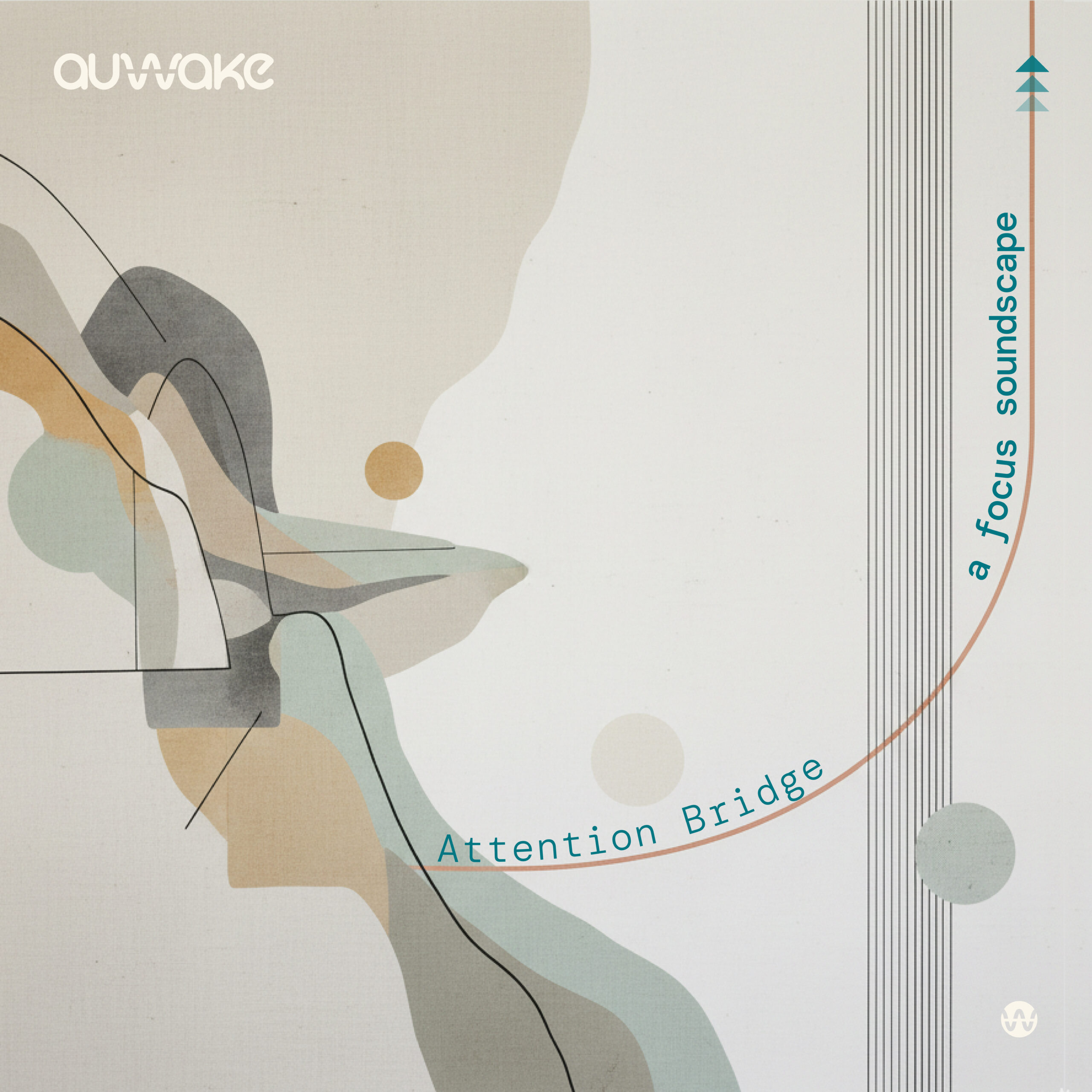
A practical example of this design philosophy is “Attention Bridge - A Focus Soundscape” by Auwake (Fatsnowed & Solangie La Rosa). Engineered as a 30-minute functional soundscape for deep study and complex intellectual work, it illustrates how targeted audio architecture actively constructs both cognitive parameters:
- Establishing Neurobiological Rhythm via a 65 BPM Cadence: Built around a steady 65 BPM cadence aligning with a relaxed yet vigilant state, offering a steady rhythmic anchor that encourages neural synchronization without overstimulation. Includes subtle analog melodies and shimmering arpeggios that prevent sensory adaptation.
- Setting Psychological Tone via Atmospheric Cushioning: Rooted in deep, warm ambient pads that gently shift in filter frequency, helping down-regulate sympathetic nervous system activity into organic calm.
- Protection of Working Memory (Lyric-Free Architecture): Remains strictly instrumental and atmospheric, avoiding linguistic processing centers and preserving 100% of working memory capacity for complex problem-solving.
- Acoustic Shielding: Abstract sonic layers mask intrusive environmental noise, reducing activation in the brain's Default Mode Network (DMN)—the neural network responsible for mind-wandering and self-referential distraction.
Asserting that "without rhythm and tone there is no flow" goes beyond metaphor—it reflects a core principle of cognitive engineering. Purpose-built neuroacoustic tools like Attention Bridge provide the external tuning fork required for deep focus and sustained immersion to become repeatable, on-demand states.